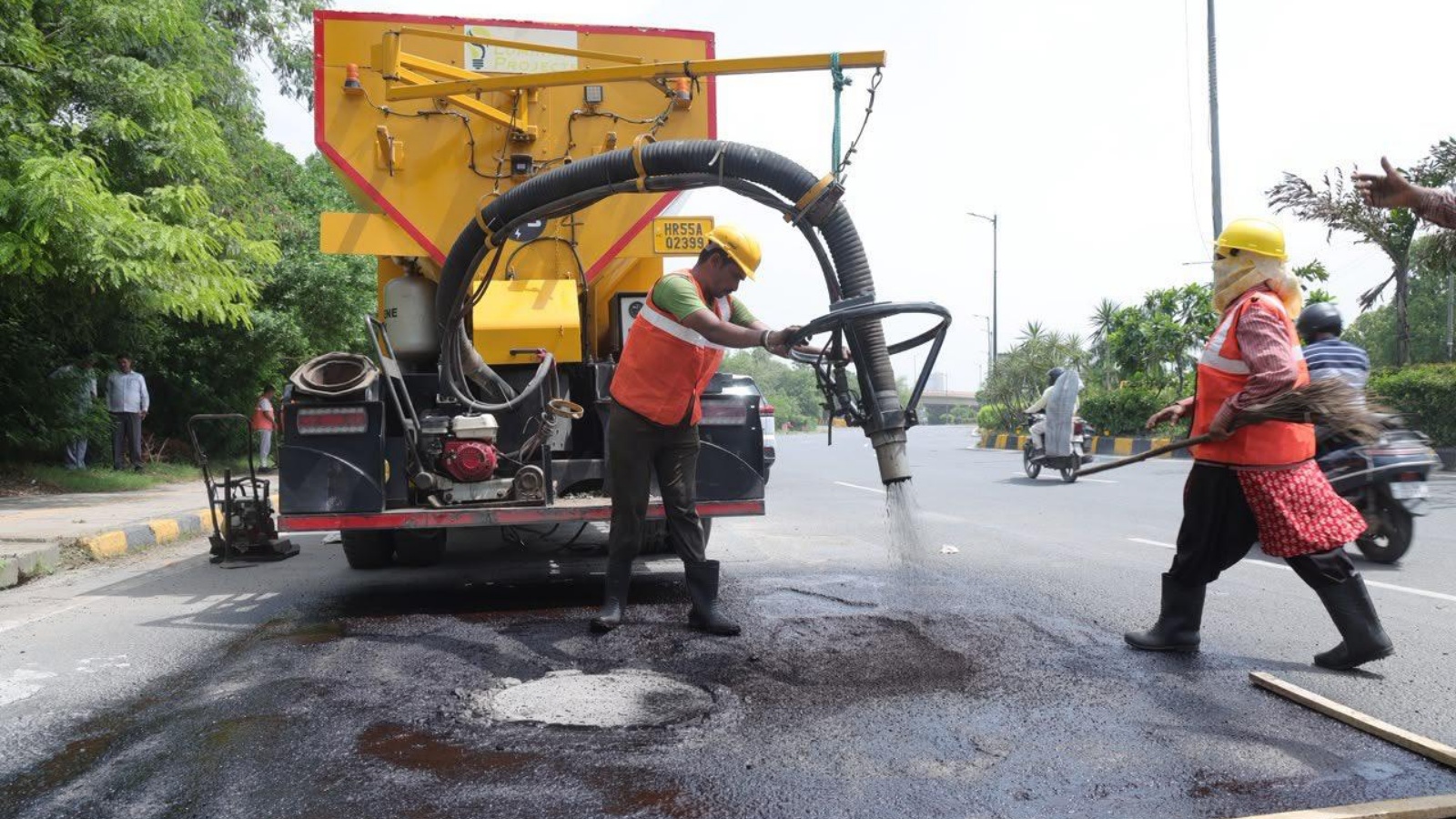
Delhi’s Public Works Department has launched a new ‘Spray, Injection, Patching’ technology that can seal potholes in under five minutes. A single machine with a small crew can repair 100‑150 potholes daily, minimizing traffic disruption.
Key Takeaways
- Potholes can be repaired in under five minutes.
- One machine with a small crew can fix 100‑150 potholes per day.
- Technology works in monsoon, offering an eco‑friendly solution.
- Bitumen emulsion bonds the fill material for long‑lasting repairs.
- Adopted already in Jammu‑Kashmir, Haryana, Maharashtra, Madhya Pradesh, Goa, Karnataka and Telangana.
Delhi’s Public Works Department (PWD) officially inaugurated trials of a new ‘Spray, Injection, Patching’ system on Tuesday. The fully mechanised, single‑machine method promises permanent pothole repair within five minutes, handling deep potholes, edge breaks, utility cuts and wide cracks across diverse road types.
How the Technology Works
The process begins with high‑velocity air to clean the pothole cavity, followed by a bonding coat of bitumen emulsion. Then, emulsion‑coated aggregate is injected under high pressure. The injection velocity itself compacts the fill, eliminating the need for a roller. Because the method is cold‑applied, it can be used year‑round, even during heavy monsoon rains.
Operational Efficiency
A mobile, self‑contained unit operated by a crew of two to three can address roughly 100‑150 potholes each day. Roads are reopened to traffic immediately after repair, reducing lane closures and commuter inconvenience across Delhi’s extensive network.
Environmental Advantages
Since the technique does not rely on hot‑mix plants, fuel consumption and emissions are markedly lower. Only the exact quantity of material required is mixed and sprayed, resulting in zero waste and a greener road‑maintenance footprint.
Wider Adoption Across India
States such as Jammu‑Kashmir, Haryana, Maharashtra, Madhya Pradesh, Goa, Karnataka and Telangana have already deployed this system for rapid, durable, and sustainable road upkeep. Delhi’s scaling of the technology could set a benchmark for other metros, encouraging nationwide uptake of low‑impact, high‑efficiency road‑repair solutions.
Experts argue that if metropolitan cities replicate Delhi’s model, India could see a dramatic uplift in road‑infrastructure quality while curbing public‑sector expenditure on recurring pothole patches.