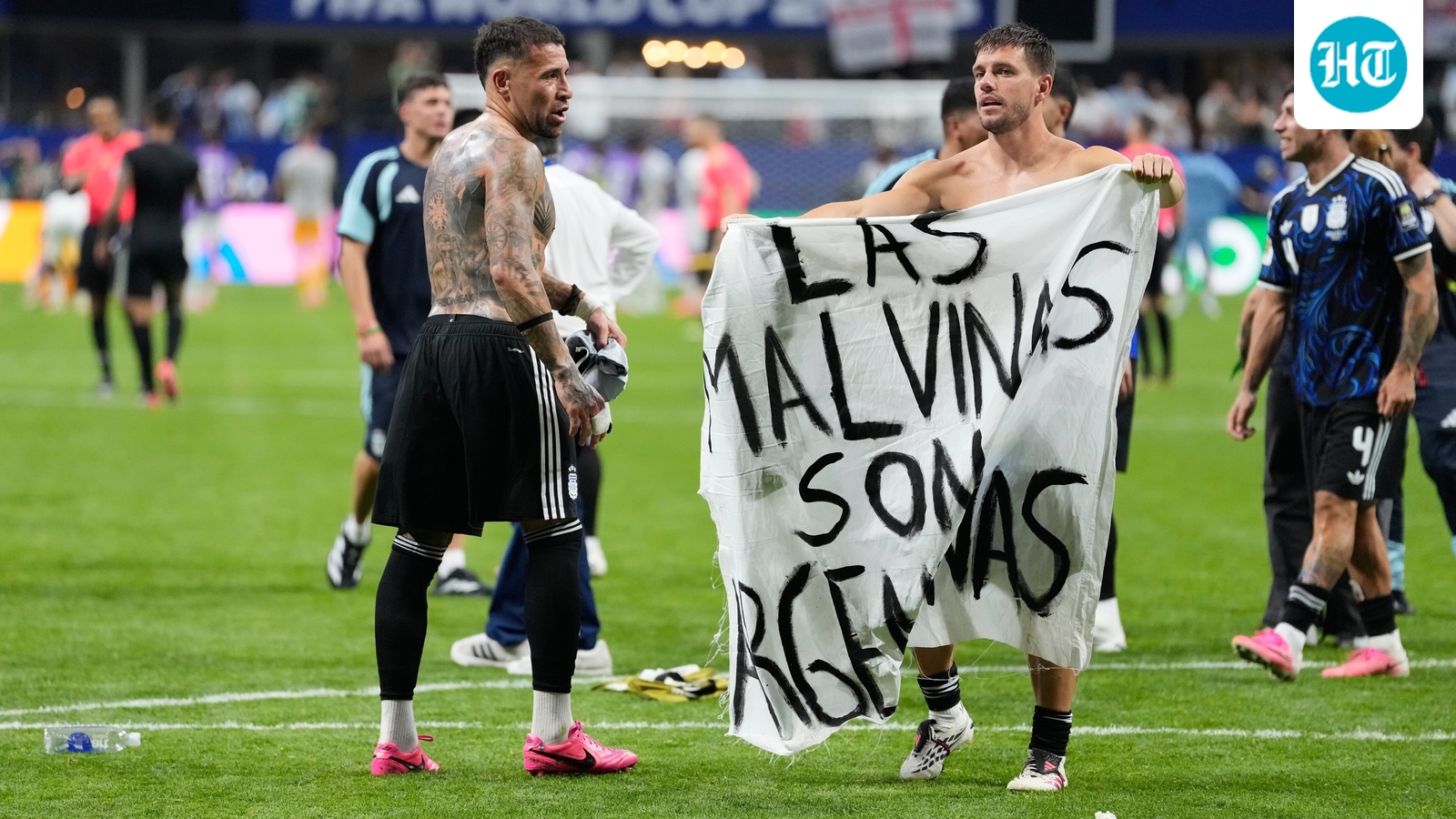
FIFA has launched an investigation into Argentina national team players Lisandro Martinez and Giovani Lo Celso for displaying a politically charged 'Las Malvinas son Argentinas' banner. The controversial incident occurred during their celebrations following a World Cup semi-final victory over England.
Key Takeaways
- FIFA's independent disciplinary committee is investigating Lisandro Martinez and Giovani Lo Celso for displaying a political banner.
- The banner read 'Las Malvinas son Argentinas' (The Falklands are Argentinian) following their World Cup semi-final win against England.
- The UK government has strongly condemned the act, while Argentine leadership, including President Javier Milei, has supported the players.
Global football governing body FIFA has officially opened an investigation into Argentina players Lisandro Martinez and Giovani Lo Celso for displaying a controversial political banner following their high-stakes World Cup semi-final victory over England. The players held up a banner reading 'Las Malvinas son Argentinas'—translating to 'The Falklands are Argentinian'—and waved it enthusiastically toward fans in the stands, reigniting a decades-old geopolitical dispute on the sporting stage.
FIFA's Stance and Historical Precedents
Under FIFA's strict disciplinary code, any display of political, religious, or personal slogans or statements during matches is strictly prohibited. A FIFA spokesperson confirmed that the independent disciplinary committee is currently assessing the match reports and considering the relevant circumstances before deciding on potential sanctions. This is not uncharted territory for the Argentine Football Association (AFA); back in 2014, they were fined £20,000 by FIFA for a nearly identical banner display before a friendly match against Slovenia.
Geopolitical Context and the UK's Reaction
The Falkland Islands, located in the South Atlantic, remain a highly sensitive subject for both nations. The sovereignty dispute escalated into a brief but bloody war in 1982, resulting in the deaths of 649 Argentine military personnel, 255 British service members, and three island residents. Commenting on the recent incident, a spokesperson for British Prime Minister Keir Starmer took a firm stance, stating, 'The World Cup might not be ours, but the Falkland Islands definitely are.' The UK government reiterated that the right to self-determination rests solely with the islanders.
Argentine Leadership Defends the Gesture
In contrast, Argentine President Javier Milei backed the players, framing their actions as an emotional response rather than a calculated political provocation. 'What the players do is understandable; they get carried away by their emotions, they act on impulse, and that will likely lead to discussions about a fine,' Milei remarked. Vice President Victoria Villarruel went a step further, sharing the image on social media and asserting that the Malvinas are intrinsically linked to the Argentine identity, regardless of stadium bans.
The Intersection of Football and National Identity
The rivalry between England and Argentina is one of the most storied in international football, deeply intertwined with the geopolitical fallout of the 1982 conflict. Diego Maradona's iconic 'Hand of God' and 'Goal of the Century' during the 1986 World Cup were famously viewed in Argentina as a form of poetic justice. This latest controversy underscores the persistent difficulty sporting bodies face in attempting to completely decouple international sports from the heavy burden of national history and sovereignty.