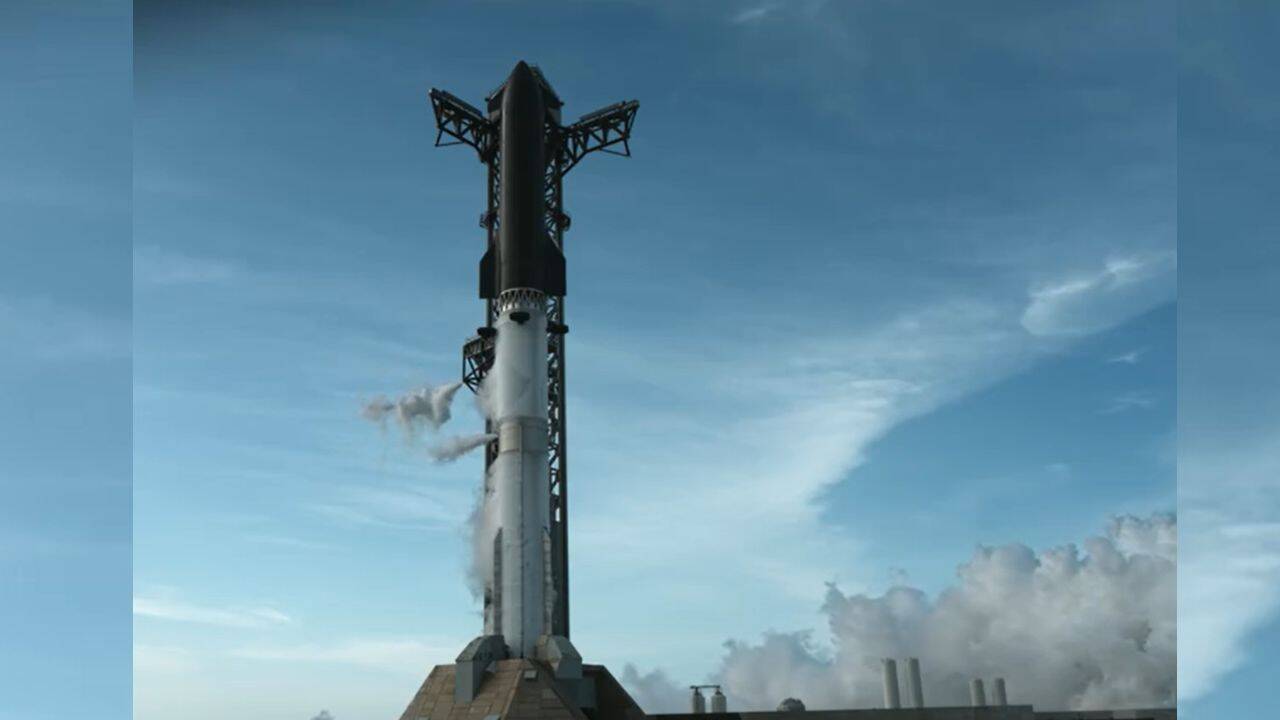
SpaceX’s Starship 13th test flight was aborted at the pad after multiple engines failed to ignite, delaying a Starlink satellite deployment and putting pressure on NASA’s lunar timetable. Elon Musk promises a retry within days.
मुख्य बिंदु (Key Takeaways)
- Starship’s 13th test flight aborted at the launch pad because several engines failed to start.
- The mission carrying 20 new Starlink satellites is delayed, affecting NASA’s moon program.
- Elon Musk announced that the next launch attempt could happen within a few days.
Washington – On July 17, 2026, SpaceX halted its most powerful launch vehicle, Starship, just seconds before liftoff during its 13th test flight. While the countdown proceeded smoothly, a partial engine ignition was observed three seconds before the scheduled launch, after which the engines shut down abruptly, leaving the rocket tethered to the pad and prompting an immediate fuel drain.
Why the Flight Matters
Starship is billed as the world’s largest and most powerful rocket, designed to ferry heavy payloads to orbit and beyond, including crewed missions to the Moon and Mars. This particular test was slated to deploy 20 of SpaceX’s newest Starlink internet satellites, capture images of the vehicle’s heat shield, and validate the vehicle’s performance on a half‑world‑circumnavigating trajectory. The abrupt engine failure, however, prevented all of these objectives from being met.
Implications for NASA’s Lunar Agenda
NASA has contracted both SpaceX and Jeff Bezos’ Blue Origin to develop lunar landers that will return astronauts to the Moon after a 50‑year hiatus. Starship, alongside Blue Origin’s “Blue Moon,” is expected to be flight‑ready for the Artemis III mission next year, allowing the newly named crew to practice docking procedures in Earth orbit. A delay in Starship’s testing cadence could compress the schedule for Artemis III and push back the subsequent Artemis IV mission, which is targeted for no earlier than 2028 and will aim to land astronauts at the Moon’s south‑polar region.
Elon Musk’s Response
Following the abort, Elon Musk posted on X, “Next launch attempt hopefully in a few days.” Weather conditions were favorable, and the partial ignition indicated that the launch system was otherwise on track. The focus now shifts to diagnosing the specific engine(s) that failed to start and implementing corrective measures before the next attempt.
Looking Ahead
SpaceX’s ambition to expand the Starlink constellation while simultaneously perfecting a vehicle capable of interplanetary travel hinges on rapid iteration and learning from setbacks. While this abort is a short‑term obstacle, it underscores the high‑stakes nature of human spaceflight development. If the company resolves the engine issue swiftly, it can resume its cadence of test flights, keep Starlink deployment on schedule, and maintain its pivotal role in NASA’s return‑to‑the‑Moon roadmap.