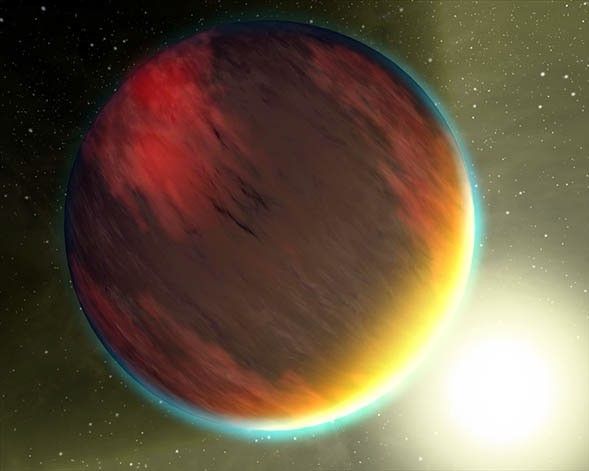
Astronomers have detected helium loss on an exoplanet orbiting LHS 1140, providing a vital clue to the evolutionary life cycle of planetary atmospheres.
Key Takeaways
- Researchers have observed helium escaping the atmosphere of a rocky exoplanet orbiting the star LHS 1140.
- The rate of helium loss allows scientists to predict the composition of the planet's future atmosphere.
- Planetary evolution involves the gradual loss of light elements like hydrogen and helium over billions of years.
The vast majority of gas in our universe consists of a primordial mixture of hydrogen and helium. It is widely theorized that the nascent atmospheres of most planets begin with this specific composition. However, as planets undergo billions of years of evolutionary changes, their atmospheric chemistry shifts dramatically. Through chemical reactions or direct escape into space, these light elements are gradually depleted.
The Complexity of Atmospheric Retention
This phenomenon is evident in our own solar system. Planets like Venus, Earth, and Mars are believed to possess 'secondary atmospheres.' Their original hydrogen and helium envelopes were likely lost or transformed long ago. The mechanics of this loss are incredibly nuanced; while lighter elements escape more easily, hydrogen can sometimes be 'shielded' by integrating into complex molecules like methane or ammonia.
A Breakthrough Observation: LHS 1140
A groundbreaking study published in the journal Nature has provided empirical evidence of this process in deep space. Astronomers have observed helium being stripped from the atmosphere of an exoplanet orbiting the star LHS 1140, located approximately 50 light-years away. By measuring the specific rate at which helium is escaping, scientists can now make sophisticated inferences about what the planet's remaining atmosphere will look like in the future.
The Interplay of Gravity and Radiation
Several celestial factors dictate whether a planet retains its atmosphere. A planet's gravitational pull acts as a tether for molecules, while a robust magnetic field can serve as a shield against stellar radiation. Conversely, proximity to a host star plays a dual role: intense radiation and heat can expand an atmosphere to such an extent that gravity can no longer hold it, leading to massive atmospheric depletion.