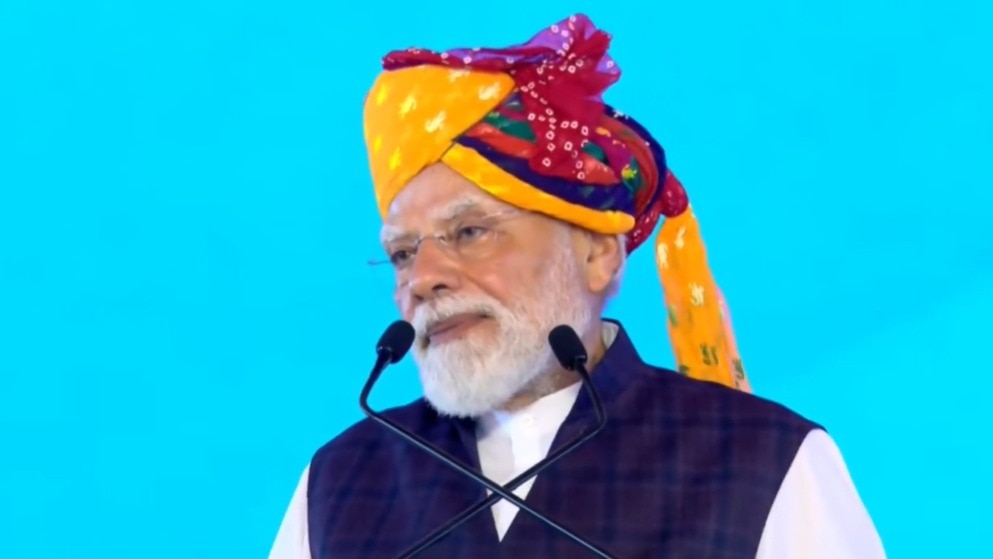
Prime Minister Narendra Modi flagged off India's first hydrogen-powered train from Haryana's Jind, hailing it as a milestone for 'Aatmanirbhar Bharat'. Highlighting global energy crises, including tensions in the Strait of Hormuz, PM Modi emphasized how green technology secures India's transport infrastructure.
Key Takeaways
- PM Modi flagged off the first hydrogen train between Jind and Sonipat in Haryana.
- The train is a landmark 'Make in India' project, completely smoke-free and equipped with advanced safety sensors.
- PM Modi highlighted the US-Iran conflict in the Strait of Hormuz to emphasize the need for energy self-reliance.
In a monumental stride toward sustainable public transport and technological self-reliance, Prime Minister Narendra Modi flagged off India's first hydrogen-powered train from Haryana’s historic Jind railway station. Operating between Jind and Sonipat, this state-of-the-art train represents a landmark achievement for the 'Make in India' initiative, ushering the nation into an elite club of countries utilizing clean hydrogen fuel for mass transit.
Technological Marvel & Safety Systems
Addressing a massive gathering, the Prime Minister emphasized the ecological and technological prowess of the new train. Terming it "one of the most powerful and eco-friendly trains in the world," PM Modi highlighted that the locomotive is entirely zero-emission, releasing only water vapor and warm air. To ensure passenger safety, the train is equipped with cutting-edge automated systems designed to detect hydrogen leakage, excessive heat, fire, and smoke instantly, mitigating risks associated with highly volatile hydrogen fuel.
Geopolitical Context & Energy Security
Beyond the domestic milestone, PM Modi placed the launch within a broader global geopolitical context. He drew attention to the escalating tensions between the United States and Iran, which have severely disrupted maritime trade in the critical Strait of Hormuz. Noting that a significant portion of India's crude oil, diesel, and liquefied petroleum gas (LPG) imports pass through this volatile Gulf region, the PM warned of the vulnerabilities associated with over-reliance on fossil fuels.
Comparing Eras: Pre-2014 vs. Present
Drawing a sharp contrast with the pre-2014 era, PM Modi asserted that a similar global energy crisis a decade ago would have crippled the Indian Railways. "Before 2014, a vast majority of our rail network relied heavily on diesel. Any disruption in international oil supplies would have brought our transport system to a grinding halt," he remarked. He credited his administration's aggressive push toward 100% electrification and alternative green fuels for insulating India's economy from external geopolitical shocks.
The Road to Net-Zero Carbon
The introduction of hydrogen trains marks a pivotal phase in India's National Green Hydrogen Mission, which aims to position the country as a global hub for the production and export of clean energy. As Indian Railways targets becoming a 'Net Zero Carbon Emitter' by 2030, the successful deployment of hydrogen-powered propulsion systems in regional networks paves the way for a cleaner, resilient, and technologically sovereign transport ecosystem.