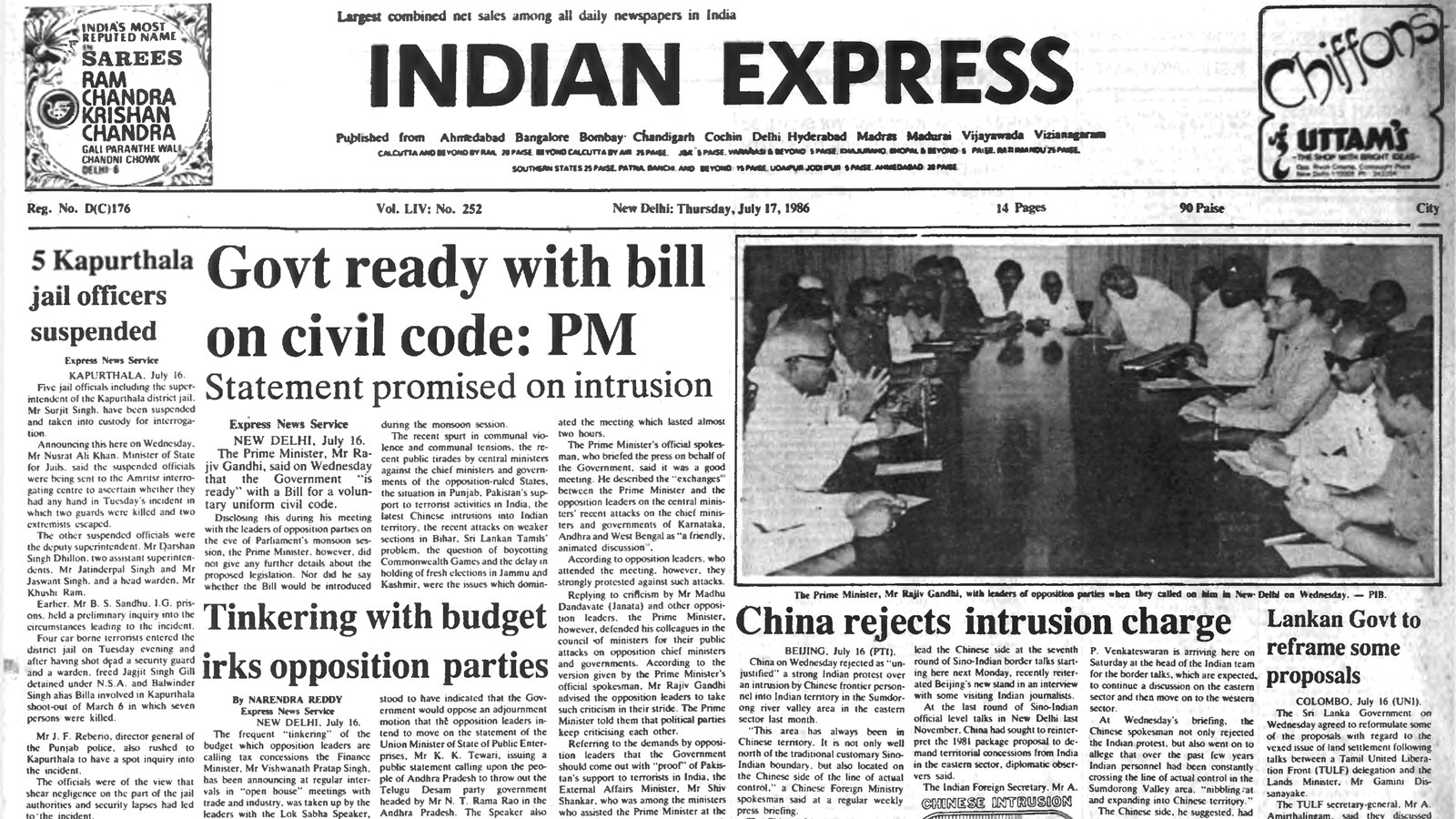
A retrospective look at July 17, 1986, when Prime Minister Rajiv Gandhi announced the readiness of a voluntary Uniform Civil Code (UCC) Bill. The era was also marked by heightened geopolitical tensions, including a Chinese intrusion in the Sumdorong Chu Valley and US-Pakistan nuclear dynamics.
Key Takeaways
- PM Rajiv Gandhi announced that the draft for a voluntary Uniform Civil Code (UCC) was ready.
- China rejected India's protest over military intrusion in the Sumdorong River Valley.
- The United States maintained that Pakistan did not possess a nuclear bomb, despite intelligence reports.
On July 17, 1986, Prime Minister Rajiv Gandhi made a landmark announcement on the eve of the Parliament's monsoon session, stating that the government had prepared a draft for a voluntary Uniform Civil Code (UCC). The issue of UCC was highly charged, coming on the heels of the controversial Shah Bano judgment of 1985, which had sparked intense national debate over religious personal laws versus gender justice. Although Rajiv Gandhi did not commit to a timeline for introducing the bill, the announcement itself was a significant political marker, showcasing the complex tightrope the administration was walking between reform and appeasement.
Sino-Indian Border Tensions in the Eastern Sector
Simultaneously, geopolitical friction on India’s northern frontier escalated as Beijing rejected New Delhi's strong protest regarding Chinese military intrusion into the Sumdorong Chu Valley in the eastern sector (Arunachal Pradesh). China claimed the region was historically its territory and fell on its side of the Line of Actual Control (LAC). This standoff in the Sumdorong Chu Valley would eventually lead to a major military mobilization by both sides, culminating in India's Operation Chequerboard and testing the diplomatic resilience of the two Asian giants.
The Sri Lankan Ethnic Crisis
On the southern front, regional diplomacy was heavily focused on the Sri Lankan ethnic conflict. The Sri Lankan government, led by J.R. Jayewardene, agreed to reframe land settlement proposals following talks with the Tamil United Liberation Front (TULF) delegation, led by A. Amirthalingam. The discussions centered on Annexure 'C' of the government's proposals, a crucial element in resolving the vexed ethnic issue that would eventually lead to the signing of the Indo-Sri Lanka Accord in 1987.
The US-Pakistan Nuclear Matrix
Adding to India's security anxieties, the United States administration continued to downplay Pakistan's nuclear weapons program. Despite CIA intelligence suggesting that Islamabad was close to possessing a bomb and had enriched uranium beyond the 5% limit at the Kahuta plant, Washington insisted that Pakistan did not have the bomb. This stance was largely seen as a strategic necessity for the US to continue its $3.2 billion aid package to Pakistan, which served as a vital conduit for funding Afghan Mujahideen against Soviet forces.
Legacy & Modern Analysis
Looking back four decades, the events of July 1986 highlight the cyclical nature of Indian political and geopolitical challenges. The debates surrounding the Uniform Civil Code, border disputes with China, regional stability in South Asia, and the double standards of global non-proliferation regimes remain highly relevant today. The archival records serve as a stark reminder of how historical policy decisions continue to shape contemporary Indian statecraft.