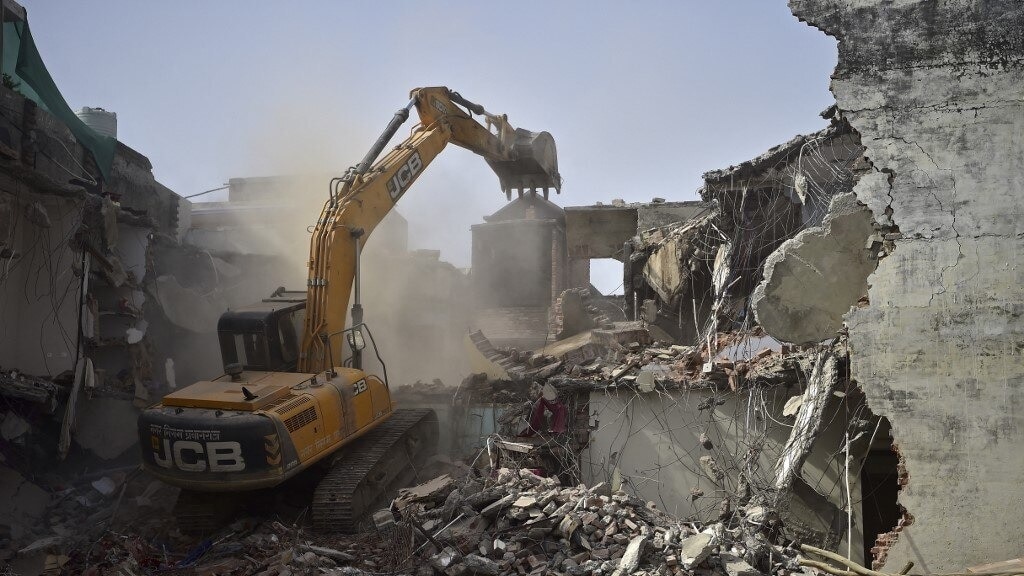
The Supreme Court has declined to impose a total ban on demolition drives but cautioned authorities against using bulldozers as a tool for selective punishment.
Key Takeaways
- The Supreme Court refused to impose a blanket ban on the use of bulldozers for demolitions.
- The Bench emphasized that demolition drives must follow 'due process' and cannot be used to selectively target individuals.
- All pending contempt petitions regarding alleged arbitrary demolitions have been transferred to respective High Courts.
- The Court ruled that factual disputes regarding encroachments must be adjudicated by High Courts rather than through contempt proceedings.
New Delhi: In a significant ruling that balances administrative authority with constitutional safeguards, the Supreme Court of India has declined to impose a blanket ban on 'bulldozer actions.' While acknowledging the necessity of removing illegal encroachments to uphold the rule of law, the apex court issued a stern warning against 'selective targeting' and the use of demolition drives as a punitive tool against specific individuals or communities.
Upholding the Rule of Law vs. Selective Punishment
A bench led by Chief Justice of India Surya Kant, along with Justice Joymalya Bagchi and Justice V. Mohana, was hearing multiple contempt petitions alleging that authorities had violated the landmark directions issued in November 2024. The court observed that while bulldozers are necessary when 'comfortable corruption' between authorities and encroachers thwarts the law, the administration cannot use the guise of law enforcement to engage in character assassination or targeted punishment.
The Necessity of Due Process
Justice Bagchi highlighted a critical legal nuance, stating that the fundamental question in any demolition case is whether the person had legal authorization and whether the due process of law was strictly followed. The court emphasized that demolition orders should not be treated as standalone statutes but must be read alongside the specific legal exceptions and safeguards established by the judiciary. The bench noted that the court cannot adjudicate every factual controversy through contempt proceedings, as these require deep scrutiny of records, notices, and timelines.
Transfer of Petitions to High Courts
Addressing allegations of 'arbitrary' and 'punitive' demolitions—including claims made by senior advocates regarding politically motivated actions and media-sensationalized demolitions—the Supreme Court decided to transfer all pending contempt petitions to the respective High Courts. The Bench ruled that High Courts are the appropriate forums to examine whether the safeguards laid down by the apex court were breached. The High Courts have been empowered to summon official records and seek evidence through district courts to ensure a fair determination of facts.
Implications for Administrative Action
This judgment serves as a middle ground. It prevents the paralysis of municipal authorities who need to clear public land and roads, while simultaneously creating a judicial shield for citizens against the misuse of state machinery. By shifting the burden of factual investigation to the High Courts, the Supreme Court has ensured that 'bulldozer justice' remains subject to the rigorous scrutiny of the constitutional legal framework.