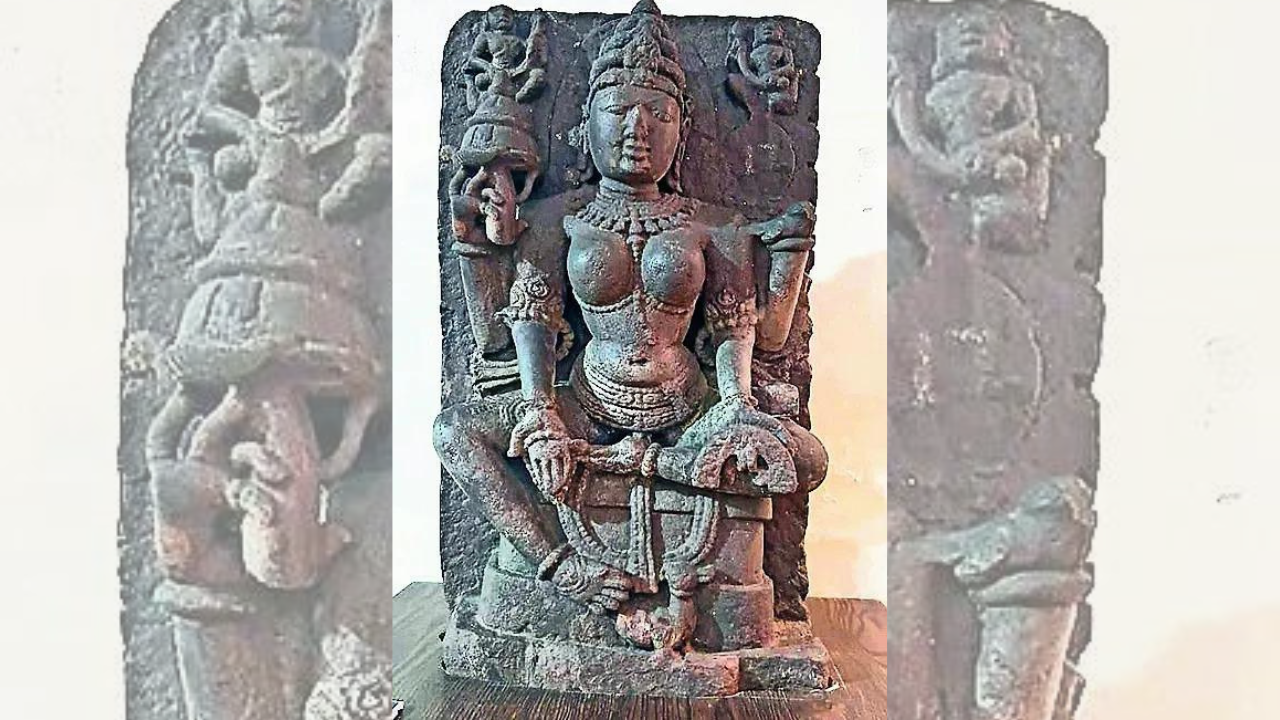
A 12th‑century red sandstone statue in Bhopal's State Museum, long labelled as Saraswati, has been scientifically re‑identified as the goddess Gayatri. Digital documentation and high‑resolution 3D mapping revealed iconographic clues missed for centuries, finally correcting a nine‑century error.
Key Takeaways
- 12th‑century sculpture identified as Goddess Gayatri
- Digital 3D mapping uncovered missed iconographic details
- New digital presentation strengthens India's heritage narrative
The striking red sandstone statue from Dhar, displayed at Bhopal's State Museum, was for over 900 years worshipped and catalogued as the goddess Saraswati. Recent scientific scrutiny, however, has confirmed that the figure is actually Goddess Gayatri, one of the rareest known depictions of the Vedic mantra‑embodying deity.
Digital Tools Reveal Hidden Clues
Archaeologist Ramesh Yadav and his team employed high‑resolution 3D scanning and comprehensive digital documentation to analyse every nuance of the sculpture. The data uncovered iconographic elements that align precisely with classical descriptions of Gayatri in the Silpa‑Śāstras: four arms holding a rosary, a lotus, and the Vedas, plus a finely carved swan (hamsa) symbolising sacred wisdom.
Absence of the Veena Seals the Verdict
Since the Gupta period, Saraswati is almost invariably depicted with a veena. This statue lacks the instrument entirely, instead presenting the Vedas and lotus as prescribed in the Srimad Devi Bhagavata Purana and the Silpa‑Śāstras for Gayatri. Historian‑archaeologist BK Lokhande notes, “The missing veena is the decisive factor that distinguishes Gayatri from Saraswati.”
Historical and Artistic Context
Unearthed in Dhar, the former capital of the Parmar dynasty (9th‑14th century), the sculpture exhibits distinct Western Chalukyan influences in its graceful modelling and ornamentation while faithfully reflecting classical Gayatri iconography. Gayatri, celebrated in the Rigveda and later texts as the mother of the Vedas, the mantra‑mother, and the universal mother, occupies a pivotal place in Vedic tradition.
Role in Madhya Pradesh’s Digital Heritage Mission
The re‑identified image is now the flagship visual for Madhya Pradesh’s Digital Heritage Mission. Archaeology Commissioner Madan Kumar Nagargoje explained that authenticated 3D models and online platforms will allow scholars and the public to study this rare Gayatri image remotely, enhancing both academic research and public engagement with India’s cultural patrimony.